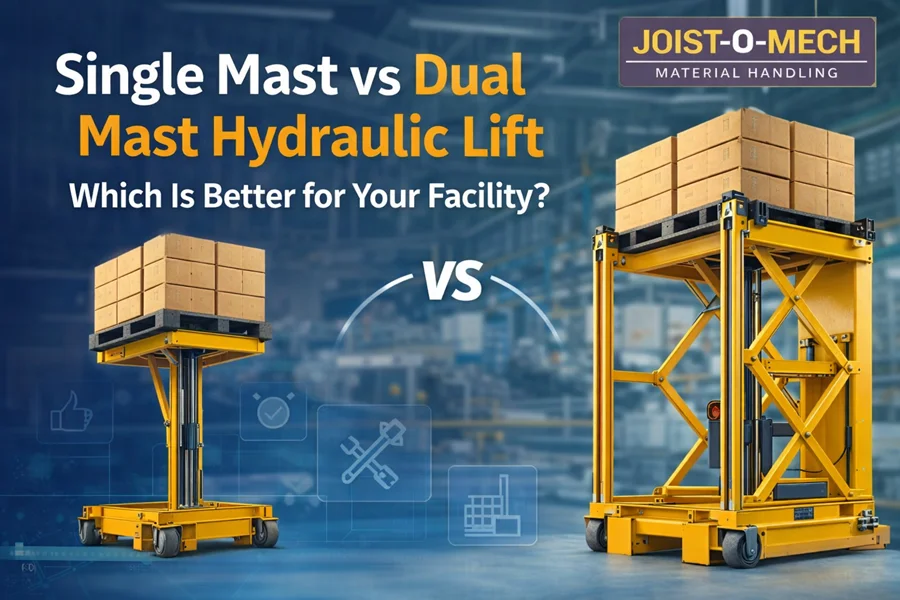
When industries plan to improve vertical material movement, hydraulic lifts often become the preferred solution due to their reliability, safety, and load-handling capability. However, one of the most common questions decision-makers face is:
Should we choose a Single Mast Hydraulic Lift or a Dual Mast Hydraulic Lift?
Both lift types are widely used in factories, warehouses, and industrial plants, but they serve different operational needs. Selecting the wrong configuration can lead to stability issues, space constraints, or unnecessary cost escalation.
This guide explains the difference between single mast and dual mast hydraulic lifts, compares their performance, and helps you decide which option is better for your facility.
Understanding Mast Configuration in Hydraulic Lifts
In hydraulic lifts, the mast is the vertical structural element that guides and supports the lifting platform.
The number of masts directly affects:
- Load stability
- Lifting capacity
- Platform size
- Overall safety
Let’s understand each type in detail.
What Is a Single Mast Hydraulic Lift?
A Single Mast Hydraulic Lift uses one central vertical mast to guide the lifting platform. It is typically compact and designed for moderate loads and limited vertical travel.
Key Characteristics
- One central mast for guidance
- Compact footprint
- Simple structure
- Lower installation complexity
Common Applications
- Small manufacturing units
- Warehouses with limited space
- Assembly lines
- Maintenance and material transfer at low heights
What Is a Dual Mast Hydraulic Lift?
A Dual Mast Hydraulic Lift uses two parallel vertical masts, providing enhanced stability and load distribution. It is engineered for heavier loads and greater lifting heights.
Key Characteristics
- Two vertical masts for balanced support
- Higher load capacity
- Better platform stability
- Suitable for heavy-duty operations
Common Applications
- Heavy manufacturing plants
- Automotive and engineering units
- Multi-floor material transfer
- Continuous industrial operations
Single Mast vs Dual Mast Hydraulic Lift – Detailed Comparison
1. Load Capacity
Single Mast Hydraulic Lift: Suitable for light to medium loads. Ideal when material weight is controlled and predictable.
Dual Mast Hydraulic Lift: Designed for heavy-duty applications where higher load capacity and stability are critical.
Winner: Dual Mast Hydraulic Lift (for heavy loads)
2. Stability and Safety
Single Mast: Adequate stability for smaller platforms and lower heights.
Dual Mast: Superior stability due to load distribution across two masts, especially at higher lifting heights.
Winner: Dual Mast Hydraulic Lift
3. Space Requirement
Single Mast: Requires less installation space and is ideal for compact facilities.
Dual Mast: Requires more space but offers better performance for larger platforms.
Winner: Single Mast Hydraulic Lift (for space-constrained facilities)
4. Lifting Height
Single Mast: Best for low to moderate lifting heights.
Dual Mast: Handles higher vertical travel safely and efficiently.
Winner: Dual Mast Hydraulic Lift
5. Cost Consideration
Single Mast: Lower initial investment and reduced installation cost.
Dual Mast: Higher upfront cost but better long-term performance for heavy usage.
Winner: Depends on application and budget
6. Maintenance & Lifecycle
Single Mast: Easier maintenance due to simpler structure.
Dual Mast: Slightly higher maintenance effort but longer service life in demanding conditions.
Winner: Application-dependent
Which Hydraulic Lift Is Better for Your Facility?
The answer depends on how and where the lift will be used.
Choose a Single Mast Hydraulic Lift If:
- Load capacity requirements are moderate
- Space availability is limited
- Lifting height is relatively low
- Budget optimization is a priority
Choose a Dual Mast Hydraulic Lift If:
- Heavy loads are handled regularly
- Higher lifting heights are required
- Platform stability is critical
- The lift is part of a continuous industrial process
Role of Customization in Hydraulic Lift Selection
Standard lift models may not always meet specific industrial requirements. Factors such as:
- Unusual load dimensions
- High-frequency operation
- Integration with conveyors or automation
- Structural constraints
often demand customized hydraulic lift solutions. A manufacturer-engineered system ensures the lift is designed around your process, not forced into it.
Why Manufacturer-Designed Hydraulic Lifts Perform Better
Working directly with a manufacturer like Joist-O-Mech offers key advantages:
- Application-specific engineering
- Higher safety compliance
- Better structural integrity
- Long-term service support
- Custom-built solutions for Indian industrial conditions
Manufacturer-designed hydraulic lifts deliver better ROI, safety, and operational efficiency.
Common Mistakes to Avoid When Choosing Between Single and Dual Mast Lifts
- Selecting based only on initial price
- Ignoring future load expansion
- Overlooking stability at higher lift heights
- Choosing standard models for complex applications
Avoiding these mistakes ensures long-term reliability and safety.
Conclusion
There is no universal “best” hydraulic lift—only the right lift for your facility.
- Single Mast Hydraulic Lifts are ideal for compact spaces and moderate loads.
- Dual Mast Hydraulic Lifts are better suited for heavy-duty, high-stability, and multi-floor applications.
By evaluating load, height, space, safety, and future scalability, industries can confidently select the most suitable hydraulic lift configuration and maximize operational efficiency.