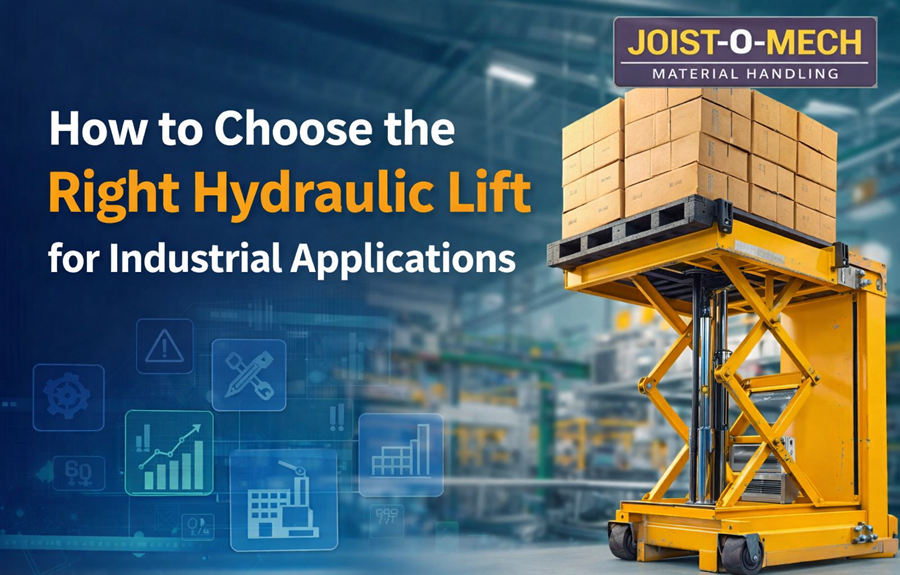
In modern industrial environments, efficient and safe vertical material movement is critical. Whether it is a manufacturing plant, warehouse, automotive unit, or heavy engineering facility, selecting the right hydraulic lift directly impacts productivity, safety, and operational cost.
However, choosing the wrong type of hydraulic lift can lead to underperformance, frequent breakdowns, safety risks, and compliance issues. This guide explains how to choose the right hydraulic lift for industrial applications, covering load requirements, lift types, safety standards, and customization needs—so decision-makers can make an informed investment.
What Is a Hydraulic Lift?
A hydraulic lift is an industrial lifting solution that uses hydraulic power to raise and lower heavy loads vertically. It works on Pascal’s principle, where pressure applied to a confined fluid is transmitted equally, enabling smooth and controlled lifting.
Hydraulic lifts are widely preferred in industrial settings due to:
- High load-handling capability
- Smooth and stable operation
- Lower maintenance compared to mechanical systems
- Better safety control for material handling
Step 1: Understand Your Industrial Application
Before selecting a hydraulic lift, it is essential to clearly define where and how it will be used. Key questions to ask:
- Is the lift required for goods only or goods with operators?
- Will it be used in manufacturing, warehousing, automotive, pharma, or heavy engineering?
- Is the operation continuous, intermittent, or occasional?
- Is the environment indoor, outdoor, dusty, or cleanroom-grade?
The application determines the type, capacity, and safety configuration of the hydraulic lift.
Step 2: Identify the Correct Type of Hydraulic Lift
Different industrial needs require different hydraulic lift configurations.
Common Types of Industrial Hydraulic Lifts:
- 1. Goods Hydraulic Lift :
- 2. Single Mast Hydraulic Lift :
- 3. Dual Mast Hydraulic Lift :
- 4. Vertical Hydraulic Lift :
- 5. Industrial Hydraulic Lift :
Designed exclusively for vertical movement of materials between floors. Ideal for warehouses, factories, and logistics hubs.
Compact solution for moderate loads and limited vertical travel. Suitable for small industrial spaces.
Provides higher stability and load capacity. Used in heavier industrial applications.
Used where floor space is limited and vertical movement is frequent. Often integrated into multi-floor facilities.
Heavy-duty systems engineered for continuous operation in demanding environments.
Choosing the correct type ensures structural stability, safety, and long service life.
Step 3: Calculate Load Capacity Accurately
One of the most common mistakes industries make is underestimating load requirements. When calculating capacity, consider:
- Maximum load weight (including pallets, cages, or containers)
- Dynamic load during movement
- Future capacity expansion
- Recommended safety margin (typically 25–30%)
Selecting a hydraulic lift with insufficient capacity can lead to system failure and safety hazards, while over-sizing unnecessarily increases cost.
Step 4: Determine Lifting Height and Travel Requirements
The lifting height should be defined based on:
- Floor-to-floor height
- Dock or mezzanine level
- Clearance required at the top and bottom
For multi-level facilities, precise height planning ensures smooth integration with existing infrastructure and avoids civil modification issues later.
Step 5: Focus on Safety Features and Compliance
Safety is non-negotiable in industrial material handling. Essential safety features include:
- Overload protection system
- Safety locking valves
- Emergency stop mechanism
- Guide rails and enclosures
- Anti-fall protection
Ensure the hydraulic lift complies with **Indian industrial safety norms** and is designed for long-term safe operation. A manufacturer-engineered system offers better compliance assurance than off-the-shelf solutions.
Step 6: Evaluate Space Constraints and Installation Conditions
Industrial facilities often face space limitations. Before finalizing a hydraulic lift, assess:
- Available shaft or pit space
- Headroom clearance
- Entry and exit points
- Structural load-bearing capacity
In many cases, customized hydraulic lifts are required to fit site-specific constraints without compromising performance.
Step 7: Consider Customization and Future Scalability
Standard hydraulic lifts may not always meet complex industrial requirements. Customization may be required for:
- Unusual load dimensions
- High-capacity or high-frequency operation
- Integration with conveyors or automation systems
- Harsh industrial environments
A manufacturer with in-house engineering capability can design lifts that align perfectly with operational needs and allow scalability for future expansion.
Step 8: Maintenance, Reliability, and Lifecycle Cost
The true cost of a hydraulic lift is not just the purchase price, but the total lifecycle cost. Key factors to evaluate:
- Ease of maintenance
- Availability of spare parts
- Energy efficiency
- Downtime impact
Well-designed hydraulic lifts offer lower maintenance and higher uptime, making them cost-effective over the long term.
Why Choose a Manufacturer-Engineered Hydraulic Lift?
Working directly with a manufacturer like Joist-O-Mech ensures:
- Application-specific engineering
- Higher build quality
- Compliance-driven design
- Customization flexibility
- Long-term service support
Manufacturer-built hydraulic lifts are designed for industrial realities, not generic use cases.
Common Mistakes to Avoid When Selecting a Hydraulic Lift
- Choosing based on price alone
- Ignoring future capacity requirements
- Overlooking safety compliance
- Selecting standard models for complex applications
- Not considering installation constraints
Avoiding these mistakes can significantly improve ROI and operational efficiency.
Conclusion
Choosing the right hydraulic lift for industrial applications requires a clear understanding of load, height, safety, space, and operational needs. A well-selected hydraulic lift improves productivity, enhances workplace safety, and reduces long-term costs.
For more information about forklift safety or to schedule operator training, contact our team of material handling experts today.