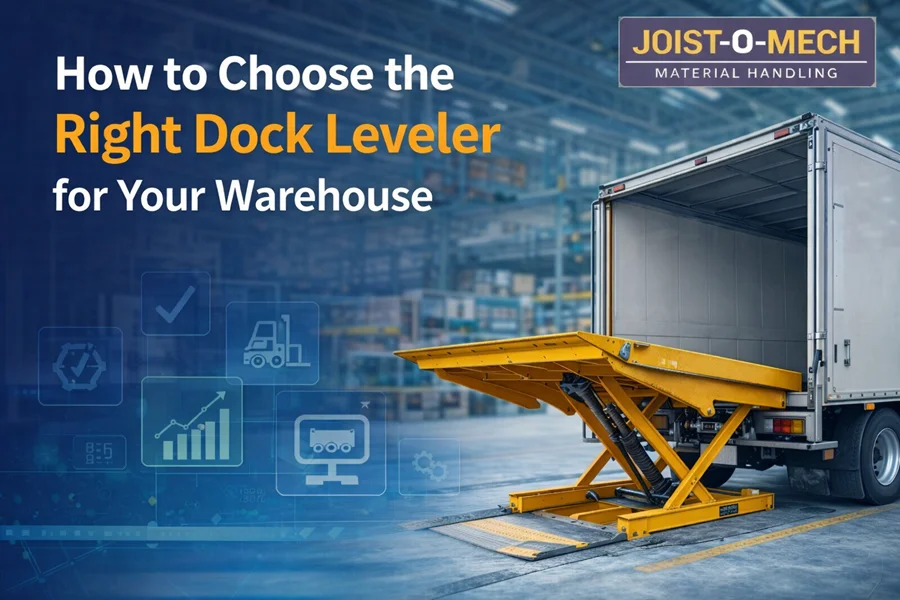
Warehouses are no longer just storage spaces. In today’s supply chains, they function as high-throughput operational hubs where speed, safety, and efficiency directly affect business performance. One of the most critical—but often underestimated—components of warehouse infrastructure is the dock leveler.
A dock leveler bridges the height gap between the warehouse dock and the transport vehicle, enabling smooth movement of goods using forklifts and pallet trucks. Choosing the right dock leveler for your warehouse is not just an equipment decision; it is a safety, productivity, and long-term reliability decision.
This guide explains how to choose the right dock leveler for warehouse operations in India, covering types, load calculations, safety requirements, and real-world operational considerations.
What Is a Dock Leveler and Why Warehouses Need It
A dock leveler is a piece of loading dock equipment designed to compensate for height differences between a warehouse floor and a truck bed. Since vehicle heights vary depending on truck type, load condition, and suspension movement, a fixed dock surface alone is unsafe and inefficient.
Why Dock Levelers Are Essential in Warehouses
- Enable smooth forklift and pallet truck movement
- Reduce manual handling risks
- Prevent product damage during loading and unloading
- Improve turnaround time at loading bays
- Enhance operator safety and compliance
In Indian warehouses—where truck height variation is significant and loading volumes are high—a properly selected warehouse dock leveler becomes a critical operational asset.
Types of Dock Levelers Used in Warehouses
Different warehouse environments require different dock leveler technologies. Understanding how each type works helps in selecting the most suitable solution.
Mechanical Dock Leveler
Working principle:
Mechanical dock levelers operate using springs and manual pull chains. The operator pulls a chain to raise the deck and extend the lip, which then rests on the truck bed.
Suitable warehouse scenarios:
- Low to moderate loading frequency
- Budget-sensitive operations
- Warehouses with consistent truck types
- Facilities where power availability is limited
Mechanical dock levelers are simple and robust but depend heavily on operator effort and correct handling.
Hydraulic Dock Leveler
Working principle:
Hydraulic dock levelers use hydraulic cylinders and an electric power pack to raise and lower the platform. Operation is controlled using push buttons, ensuring smooth and controlled movement.
Suitable warehouse scenarios:
- Medium to high loading frequency
- Multi-shift warehouse operations
- Facilities prioritising safety and efficiency
- Warehouses handling varied truck heights
Hydraulic dock levelers significantly reduce operator fatigue and offer better control compared to mechanical systems.
Electro-Hydraulic Dock Leveler
Working principle:
Electro-hydraulic dock levelers are advanced hydraulic systems with integrated safety features such as automatic lip extension, emergency stop, and safety interlocks.
Suitable warehouse scenarios:
- High-volume logistics hubs
- Distribution centres with continuous operations
- Warehouses with strict safety protocols
- Facilities using heavy forklifts
These systems are designed for maximum safety, reliability, and consistency in demanding environments.
Edge Dock Leveler
Working principle:
Edge dock levelers are mounted directly at the dock edge and provide a hinged lip to bridge minor height differences.
Suitable warehouse scenarios:
- Small warehouses
- Facilities with limited pit construction possibilities
- Operations with light to moderate loads
Edge dock levelers are compact but have limited load and height adjustment capabilities.
Key Factors to Consider Before Choosing a Dock Leveler
Selecting the right dock leveler requires analysing actual warehouse conditions rather than making assumptions.
Load Capacity Calculation
Load capacity should account for:
- Maximum load weight
- Forklift weight
- Dynamic load during movement
- Recommended safety margin (typically 25–30%)
Underestimating load capacity is one of the most common causes of premature failure and safety incidents.
Truck Height Variation
Indian logistics fleets include a wide range of truck types. The dock leveler must accommodate:
- Lowest empty truck bed height
- Highest loaded truck bed height
- Suspension movement during loading
Ignoring height variation leads to unsafe slopes and operational inefficiencies.
Dock Height and Pit Requirements
Proper pit design ensures:
- Correct platform angle
- Smooth lip engagement
- Long-term structural stability
Warehouses must verify civil dimensions before finalising dock leveler specifications.
Frequency of Loading Cycles
- Low frequency → mechanical dock leveler may suffice
- Medium frequency → hydraulic dock leveler recommended
- High frequency → electro-hydraulic dock leveler preferred
Cycle frequency directly impacts wear, maintenance needs, and operator fatigue.
Forklift Type and Weight
Electric forklifts, IC forklifts, and pallet trucks exert different point loads. The dock leveler must be designed to handle the actual equipment used, not just the product weight.
Warehouse Traffic Intensity
High-traffic loading bays require:
- Faster cycle times
- Higher structural strength
- Enhanced safety systems
Dock leveler selection should align with operational intensity, not just current demand.
Safety Features That Should Never Be Ignored
Safety is non-negotiable in warehouse loading operations.
Essential Dock Leveler Safety Features
- Overload protection
- Safety interlocks
- Controlled lip extension
- Anti-fall and maintenance support systems
- Emergency stop functionality
In Indian warehouses, where manpower movement is high, these features play a vital role in accident prevention.
Mechanical vs Hydraulic Dock Leveler – Which Is Better for Warehouses?
| Parameter | Mechanical Dock Leveler | Hydraulic Dock Leveler |
|---|---|---|
| Operation | Manual | Push-button |
| Safety | Operator-dependent | Controlled & safer |
| Fatigue | Higher | Minimal |
| Maintenance | Moderate | Lower long-term |
| Suitable for | Low usage | Medium to high usage |
The choice depends on usage frequency, safety expectations, and long-term operational goals.
Common Mistakes Warehouses Make While Selecting Dock Levelers
- Under-estimating load and forklift impact
- Choosing price over operational safety
- Ignoring future warehouse expansion
- Selecting standard models for non-standard docks
Avoiding these mistakes significantly improves reliability and ROI.
When Do You Need a Customized Dock Leveler?
Customization becomes essential when:
- Dock dimensions are non-standard
- Loads exceed typical ranges
- Operations run multiple shifts
- High-traffic logistics hubs require durability
Manufacturer-engineered solutions ensure the dock leveler fits the process, not the other way around.
Benefits of Choosing a Manufacturer-Engineered Dock Leveler
Working with a manufacturer like Joist-O-Mech provides:
- Application-specific engineering
- Compliance-driven safety design
- Structural reliability
- Long-term service support
- Better lifecycle value
Manufacturer-designed dock levelers perform better in real industrial conditions than generic solutions.
Conclusion
Choosing the right dock leveler for your warehouse requires a practical evaluation of load, safety, traffic, and long-term operational needs. Mechanical, hydraulic, and electro-hydraulic dock levelers each serve specific scenarios, and there is no one-size-fits-all solution.
Warehouses that prioritise safety, efficiency, and reliability benefit from selecting dock levelers based on real usage conditions and future scalability—not just initial cost.
An informed choice leads to safer operations, faster turnaround, and sustained warehouse performance.