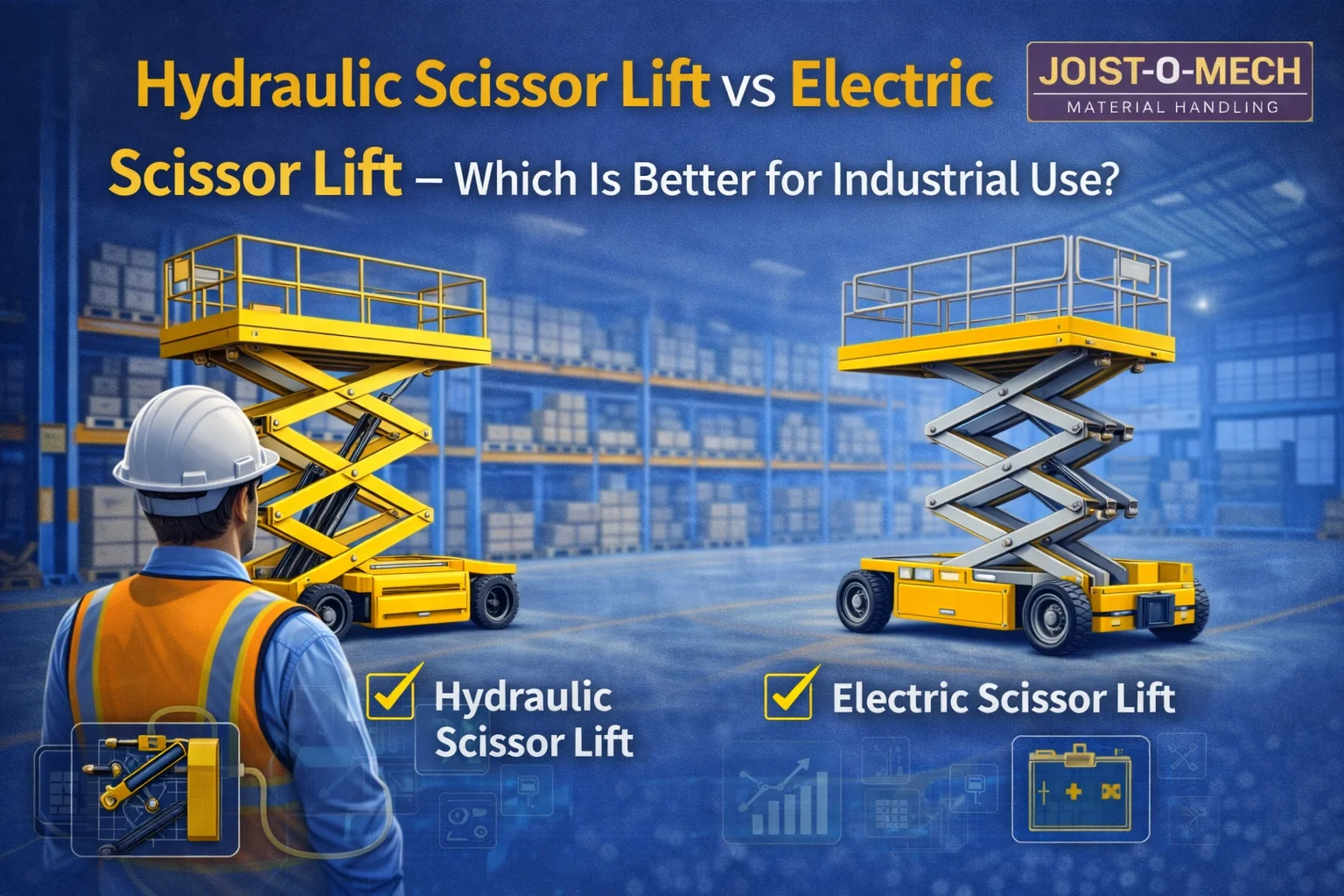
Selecting the right scissor lift for industrial use is not merely a specification exercise. It directly influences operational efficiency, load safety, energy utilization, maintenance planning, and long-term lifecycle reliability. In Indian factories and warehouses—where multi-shift operations, space constraints, and compliance expectations are increasing—the choice between a hydraulic scissor lift vs electric scissor lift must be based on engineering logic rather than preference.
Both technologies serve industrial lifting needs effectively, but their performance characteristics differ significantly under heavy-duty, continuous, and regulated working conditions. This guide provides a practical, technical comparison to help plant heads, warehouse managers, and procurement teams determine which configuration aligns with their operational environment.
Understanding Industrial Scissor Lifts
An industrial scissor lift is a vertical lifting platform that operates using a crisscross (scissor-like) mechanical linkage. As the mechanism expands, the platform rises vertically; when it retracts, the platform lowers.
Basic Working Principle
The scissor mechanism converts linear force into vertical lift. The force can be generated by:
- Hydraulic cylinders powered by a pump
- Electric motor-driven actuators or hydraulic-electric systems
The stability of the platform depends on structural rigidity, load distribution, and controlled actuation.
Role in Industrial Environments
Scissor Lifts are commonly used in:
- Manufacturing plants for material positioning
- Warehouses for order picking and maintenance
- Logistics hubs for loading and inspection
- Assembly lines for ergonomic workstation height adjustment
Why Power Source Selection Matters
The difference between hydraulic and electric actuation affects:
- Load capacity
- Energy consumption
- Noise levels
- Maintenance intervals
- Suitability for high-duty operations
Understanding these differences ensures optimal selection.
What Is a Hydraulic Scissor Lift?
A hydraulic scissor lift uses pressurized hydraulic fluid to generate lifting force.
Working Principle
The system consists of:
- Hydraulic pump
- Fluid reservoir
- Control valves
- Hydraulic cylinder
When activated, the pump pushes hydraulic fluid into the cylinder, creating pressure that extends the scissor arms and raises the platform.
Key Engineering Characteristics
- High load-handling capability
- Rugged structural design
- Reliable performance under continuous load
- Simple control mechanisms
Hydraulic systems generate strong lifting force with consistent torque output, making them suitable for demanding environments.
Typical Industrial Applications
Hydraulic Scissor Lifts are widely used in:
- Heavy-duty manufacturing plants
- Steel fabrication units
- Automotive assembly operations
- Continuous load-handling stations
They are particularly effective where lifting requirements are substantial and repetitive.
What Is an Electric Scissor Lift?
An electric scissor lift typically uses battery-powered electric motors to drive lifting mechanisms. In many configurations, the electric motor powers a hydraulic pump, while in others, it may use direct electric actuation.
Working Principle
- Electric motor generates rotational force
- Power is transmitted to lifting mechanism
- Battery system supplies energy
This configuration allows smoother and quieter operation.
Key Engineering Characteristics
- Low noise emission
- Suitable for indoor environments
- Efficient energy consumption for moderate loads
- Reduced exhaust and ventilation requirements
Typical Industrial Applications
Electric Scissor Lifts are commonly deployed in:
- Warehouse picking operations
- Maintenance platforms inside factories
- Food and pharmaceutical environments
- Clean indoor facilities
They are particularly useful in areas where noise control and emission management are priorities.
Hydraulic Scissor Lift vs Electric Scissor Lift – Detailed Comparison
| Parameter | Hydraulic Scissor Lift | Electric Scissor Lift |
|---|---|---|
| Load Capacity | Higher load handling capability | Moderate to medium loads |
| Lifting Speed | Consistent under heavy load | Smooth, efficient under moderate load |
| Energy Efficiency | Efficient for high-force lifting | Efficient for lighter-duty cycles |
| Duty Cycle Suitability | Suitable for continuous heavy-duty operations | Better for intermittent or moderate duty |
| Maintenance Requirements | Hydraulic system servicing required | Battery and motor maintenance required |
| Noise Levels | Moderate operational noise | Lower noise levels |
| Installation Complexity | May require hydraulic infrastructure | Simpler electrical integration |
| Operational Cost Efficiency | Reliable for heavy production cycles | Efficient for indoor light-to-medium use |
| Indoor vs Outdoor Suitability | Suitable for mixed environments | Primarily indoor-focused |
This hydraulic vs electric scissor lift comparison demonstrates that neither system is universally superior. The suitability depends entirely on application conditions.
Load Capacity and Duty Cycle Considerations
Heavy Industrial Loads
Hydraulic scissor lifts typically provide stronger lifting force due to pressurized fluid systems. For heavy industrial loads—such as steel components or machinery parts—hydraulic systems maintain consistent performance.
Continuous Shift Operations
In multi-shift manufacturing units, duty cycle intensity is high. Hydraulic systems often perform better under sustained heavy operation without overheating risks.
Electric Motor Limitations
Electric systems perform well in moderate-duty environments. However, in heavy continuous cycles, battery management and motor heat considerations must be evaluated.
Energy Efficiency and Operational Environment
Battery Charging Cycles
Electric scissor lifts require structured battery management:
- Scheduled charging
- Proper ventilation
- Load management
Improper battery handling reduces lifecycle performance.
Power Consumption Patterns
Hydraulic lifts consume energy during active lifting but do not rely on constant battery output for holding position.
Indoor Warehouse Suitability
Electric Scissor Lifts are advantageous in enclosed warehouses due to lower noise and absence of hydraulic fluid spillage concerns.
Ventilation Considerations
In indoor Indian facilities with limited ventilation, electric lifts offer operational comfort advantages.
Safety and Stability Considerations
Safety remains a non-negotiable factor in lift selection.
Platform Stability
Hydraulic systems provide strong support for heavier loads. However, structural design and load distribution are equally important.
Emergency Lowering Mechanisms
Both hydraulic and electric scissor lifts must include controlled emergency descent systems to prevent abrupt platform drop.
Overload Protection
Modern industrial scissor lifts incorporate overload sensors to prevent unsafe lifting.
Relevance in Indian Factories
Indian EHS expectations increasingly emphasize:
- Equipment stability
- Operator protection
- Preventive maintenance
Choosing the right lift configuration directly supports compliance.
Maintenance and Lifecycle Reliability
Hydraulic System Servicing
Hydraulic systems require:
- Periodic fluid inspection
- Seal checks
- Hose and valve maintenance
Neglect can result in leakage or pressure loss.
Electric Motor Maintenance
Electric Scissor Lifts require:
- Battery inspection
- Charging system checks
- Electrical component monitoring
Battery lifecycle planning is essential for reliability.
Downtime Implications
Improper maintenance in either system results in downtime. Lifecycle reliability depends on engineering quality and preventive servicing.
Which Is Better for Indian Industrial Applications?
For Heavy Manufacturing Units
Hydraulic Scissor Lifts are often more suitable for heavy components and continuous operation.
For Warehousing and Logistics
Electric Scissor Lifts provide smooth, quieter operation in structured warehouse environments.
For Maintenance and Access Work
Electric lifts are generally adequate for light-duty maintenance and inspection tasks.
For Multi-Shift Operations
Hydraulic systems typically handle prolonged high-load usage more consistently.
The question “which scissor lift is better for factory use” cannot be answered universally. The correct answer depends on load intensity, operational frequency, and environmental conditions.
Common Mistakes While Choosing Between Hydraulic and Electric Scissor Lifts
Industries often make decisions based on incomplete evaluation:
- Choosing based solely on noise level
- Ignoring actual duty cycle intensity
- Overlooking load calculations
- Selecting non-industrial configurations for heavy applications
These mistakes lead to reduced efficiency, increased maintenance frequency, and safety exposure.
When Do You Need a Customized Scissor Lift Solution?
Customization becomes necessary when:
- Platform dimensions are non-standard
- Loads are uneven or oversized
- Integration with conveyor systems is required
- Operations demand high-frequency lifting
Custom engineering ensures lift design matches actual workflow.
Why Manufacturer-Engineered Scissor Lifts Matter
Manufacturer-engineered scissor lifts focus on:
- Structural integrity validation
- Accurate load and stress calculations
- Compliance alignment
- Stability verification
- Long-term reliability
Engineering precision directly impacts operational safety and durability.
Conclusion
The comparison between hydraulic scissor lift vs electric scissor lift reveals that both technologies serve industrial needs effectively—when applied correctly.
- Hydraulic systems are generally better suited for heavy loads and continuous industrial duty.
- Electric systems are ideal for controlled indoor environments with moderate lifting demands.
The decision must be driven by load profile, duty cycle, facility layout, and compliance requirements—not by assumption.
A technically evaluated selection ensures productivity, safety, and long-term reliability in Indian industrial operations.