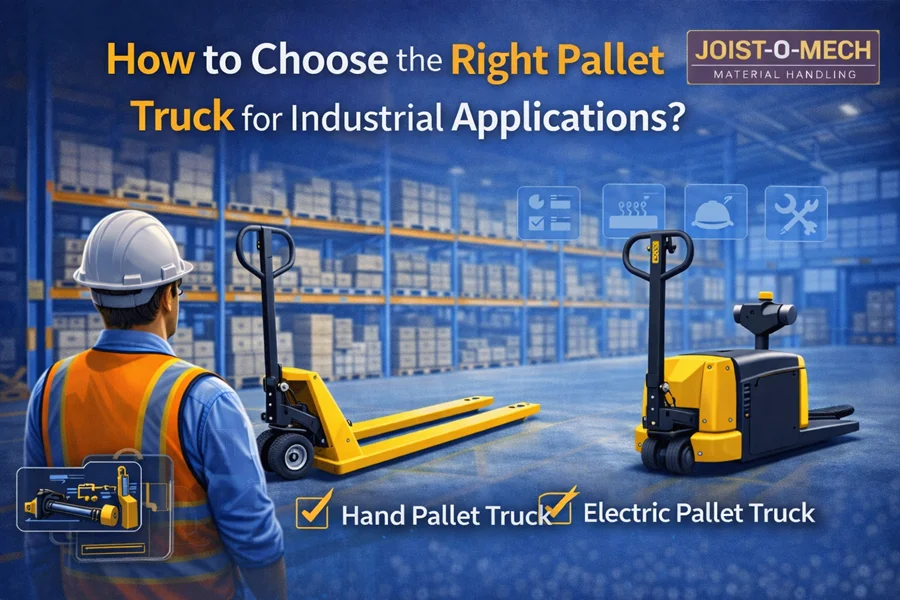
In modern warehouses and manufacturing facilities, a pallet truck is one of the most frequently used material handling tools. From unloading inbound material to feeding production lines and managing finished goods dispatch, pallet trucks play a critical role in daily operations. However, selecting the wrong pallet truck for industrial applications can result in reduced productivity, premature equipment failure, operator fatigue, and safety risks.
In Indian factories and warehouses—where floor conditions vary, load types differ, and operations often run in multiple shifts—the decision must go beyond basic specifications. A properly selected industrial pallet truck supports safe load handling, efficient movement, and long-term operational reliability.
This guide explains how to choose pallet truck configurations based on load requirements, layout constraints, duty cycle intensity, and compliance expectations.
What Is a Pallet Truck and How Is It Used in Industry?
A pallet truck, also known as a pallet jack, is a manual or powered material handling device used to lift and move palletized loads over short distances. It is widely used in warehouses, factories, logistics hubs, and distribution centers.
Basic Working Principle
The core function of a pallet truck is simple:
- Forks slide beneath a pallet.
- The operator activates a lifting mechanism.
- The pallet is raised slightly off the ground.
- The load is transported manually or using motorized assistance.
Hydraulic Lifting Mechanism
In a hand pallet truck, lifting is achieved through a hydraulic pump system:
- The operator pumps the handle.
- Hydraulic fluid pressure raises the forks.
- A release lever lowers the pallet safely.
This simple hydraulic design provides reliable vertical lift without complex components.
Role in Industrial Operations
Pallet trucks are used for:
- Intra-warehouse material movement
- Loading and unloading trucks
- Feeding assembly lines
- Short-distance pallet transfers
- Order picking operations
Because of their compact design, pallet trucks are often preferred in confined areas where forklifts may not be practical.
Types of Pallet Trucks Used in Industrial Applications
Selecting the right pallet truck begins with understanding available types and their application suitability.
Hand Pallet Truck
Working Principle
Operated manually using a hydraulic pump handle.
Suitable Environments
- Small to medium warehouses
- Low-frequency load movement
- Short-distance transfers
Hand pallet trucks are widely used due to their simplicity and low maintenance requirements.
Electric Pallet Truck
Motor-Driven Operation
Powered by battery-operated motors for traction and lifting.
Ideal Warehouse Use Cases
- High-frequency operations
- Multi-shift facilities
- Large distribution centers
Electric pallet trucks reduce operator effort and improve throughput in intensive environments.
Semi-Electric Pallet Truck
Hybrid Features
- Electric lifting
- Manual movement
Application Scenarios
- Medium-duty usage
- Warehouses transitioning to powered systems
This configuration balances manual control with powered lifting assistance.
High-Lift Pallet Truck
Ergonomic Benefits
- Raises pallets to working height
- Reduces bending and operator strain
When Required
- Assembly stations
- Packaging units
- Ergonomic-sensitive environments
High-lift pallet trucks improve workplace comfort and safety.
Stainless Steel Pallet Truck
Designed for hygienic environments such as:
- Food processing units
- Pharmaceutical facilities
- Chemical industries
Stainless steel construction resists corrosion and supports sanitation requirements.
Key Factors to Consider Before Choosing a Pallet Truck
Choosing the right pallet truck for industrial applications requires careful technical evaluation.
Load Capacity Calculation
Start with the maximum weight of palletized loads. Common industrial capacities range between 2 to 3 tonnes, but actual requirement depends on:
- Gross pallet weight
- Frequency of movement
- Safety margin
Underestimating load capacity leads to hydraulic stress and premature wear.
Load Center Concept
Load center refers to the distance from the fork face to the center of gravity of the load.
If the load center exceeds design specifications:
- Effective capacity reduces
- Stability decreases
- Risk of tipping increases
Correct load center calculation ensures safe operation.
Fork Length and Width
Fork dimensions must match pallet type:
- Standard pallets
- Euro pallets
- Customized pallets
Incorrect fork size affects balance and maneuverability.
Wheel Material Selection (PU vs Nylon vs Rubber)
Wheel type influences performance:
- PU (Polyurethane) – Quiet, suitable for smooth indoor floors
- Nylon – Durable, better for uneven or rough surfaces
- Rubber – Good shock absorption
Indian warehouses often have varied floor conditions; wheel selection should align with actual environment.
Floor Conditions
Evaluate:
- Concrete quality
- Floor joints
- Ramps or gradients
Improper wheel selection increases resistance and operator fatigue.
Frequency of Usage
For occasional use, manual pallet trucks may suffice. For multi-shift operations, electric pallet trucks improve efficiency.
Indoor vs Outdoor Operations
Outdoor use requires stronger wheel materials and weather-resistant components. Indoor facilities prioritize maneuverability and noise control.
Operator Ergonomics
Handle design, pump resistance, and braking systems affect operator comfort and safety. Poor ergonomics lead to fatigue and reduced productivity.
Manual vs Electric Pallet Truck – Which Is Better for Your Warehouse?
| Parameter | Manual (Hand Pallet Truck) | Electric Pallet Truck |
|---|---|---|
| Load Handling Effort | Higher physical effort | Reduced operator effort |
| Productivity | Suitable for low-frequency tasks | Higher throughput in busy warehouses |
| Maintenance Requirements | Minimal mechanical servicing | Battery and motor maintenance required |
| Multi-Shift Suitability | Limited | Suitable for continuous operations |
| Best-Fit Application | Small warehouses | Large, high-volume distribution centers |
The choice depends on operational intensity and layout complexity.
Pallet Truck Load Capacity and Stability Explained
Rated Capacity
Every pallet truck has a rated capacity defined under specific load center conditions. Exceeding rated capacity increases structural stress.
Hydraulic System Limits
The hydraulic cylinder has a maximum pressure rating. Continuous overloading may cause seal damage or leakage.
Importance of Load Distribution
Uneven load placement shifts center of gravity, increasing tipping risk.
Safety Implications
Incorrect loading:
- Damages hydraulic system
- Reduces wheel lifespan
- Creates operator hazard
Proper load alignment is essential for safe operation.
Pallet Truck Safety Features That Should Not Be Ignored
Industrial pallet trucks must include safety-oriented design features.
Overload Protection
Prevents lifting beyond rated capacity.
Brake Systems
Essential in sloped or ramp environments.
Ergonomic Handle Design
Reduces strain during repetitive use.
Wheel Stability
High-quality wheels ensure smooth and controlled movement.
Compliance Relevance in Indian Warehouses
With increasing focus on EHS standards, equipment safety is a core compliance requirement. Stable and reliable pallet trucks reduce workplace risk.
Common Mistakes While Selecting Pallet Trucks
Industries often make avoidable errors:
- Underestimating actual load weight
- Choosing based solely on price
- Ignoring floor type
- Selecting light-duty models for heavy applications
- Not considering future expansion
These mistakes result in reduced lifecycle performance and higher maintenance frequency.
When Do You Need a Customized Pallet Truck?
Customization becomes necessary when:
- Pallet dimensions are non-standard
- Loads exceed typical industrial weight ranges
- Special wheel materials are required
- Integration with automated workflows is needed
Application-specific engineering ensures reliable performance under demanding conditions.
Why Manufacturer-Engineered Pallet Trucks Matter
Manufacturer-engineered pallet trucks focus on:
- Structural integrity under rated loads
- Accurate load testing
- Reliable hydraulic systems
- Compliance alignment
- Long-term durability
Engineering precision directly impacts lifecycle reliability and operational safety.
Conclusion
Selecting the right pallet truck for industrial applications requires technical evaluation of load capacity, floor conditions, duty cycle intensity, ergonomic requirements, and compliance expectations.
- Manual pallet trucks are suitable for light to moderate operations.
- Electric pallet trucks enhance productivity in high-volume environments.
- Correct load calculation and wheel selection improve safety and efficiency.
An application-driven, engineering-focused selection process ensures stable, efficient, and compliant warehouse operations.
Careful evaluation today prevents operational disruption tomorrow.