Modern industrial facilities demand safe, efficient, and repeatable access to elevated work areas. From assembly lines and maintenance bays to warehouses and logistics hubs, scissor lifts play a critical role in improving productivity while reducing manual handling risks.
However, selecting the wrong scissor lift for an industrial application can result in safety incidents, operational inefficiencies, premature equipment wear, and compliance challenges. Industrial lifting requirements are fundamentally different from general-purpose or non-industrial use cases, which is why scissor lift selection must be application-driven, not assumption-based.
This guide explains how to choose the right scissor lift for industrial applications, covering lift types, load calculations, safety considerations, and real-world operating conditions commonly found in Indian factories and warehouses.
What Is a Scissor Lift and How Is It Used in Industry?
A scissor lift is a vertical lifting platform that raises and lowers loads using a crisscrossing (scissor-like) mechanism. The platform is supported by this mechanism and powered by hydraulic, electric, or mechanical systems, depending on the design.
Industrial Use vs Non-Industrial Use
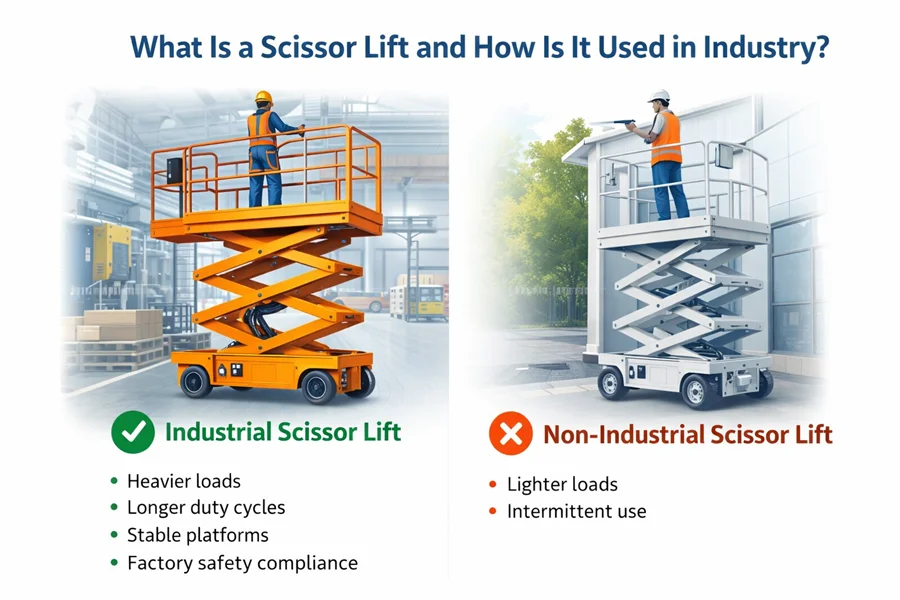
In industrial environments, scissor lifts are designed to:
- Carry heavier loads
- Operate for longer duty cycles
- Provide stable platforms for people, tools, or materials
- Comply with factory safety and structural requirements
This is very different from non-industrial or general-purpose access equipment, which is typically designed for lighter loads and intermittent use.
Typical Industrial Applications
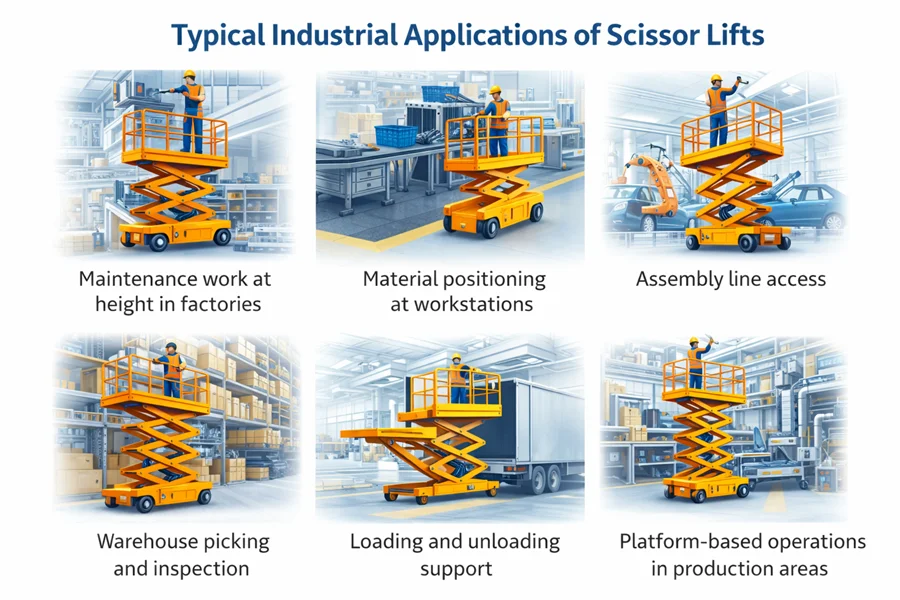
- Maintenance work at height in factories
- Material positioning at workstations
- Assembly line access
- Warehouse picking and inspection
- Loading and unloading support
- Platform-based operations in production areas
Choosing a scissor lift for industrial applications requires understanding how these conditions affect load, safety, and longevity.
Types of Scissor Lifts Used in Industrial Applications
Different industrial tasks require different scissor lift configurations. Understanding each type helps match the lift to the actual operating environment.
.webp)
Hydraulic Scissor Lift
Working principle:
Hydraulic scissor lifts use hydraulic cylinders powered by a pump to raise and lower the platform. The hydraulic system provides smooth, controlled lifting and high load-handling capability.
Best suited for:
- Heavy industrial loads
- Continuous or frequent operation
- Manufacturing plants and warehouses
- Applications where stability is critical
Hydraulic scissor lifts are widely used due to their robustness and ability to handle demanding industrial conditions.
Electric Scissor Lift
Working principle:
Electric scissor lifts are powered by electric motors and batteries, often combined with hydraulic systems for lifting.
Best suited for:
- Indoor industrial environments
- Clean or noise-sensitive areas
- Warehouses and assembly lines
- Facilities with controlled floor conditions
Electric scissor lifts are preferred where emissions, noise, and indoor safety are key considerations.
Stationary Scissor Lift
Working principle:
Stationary scissor lifts are fixed at a specific location and designed for repetitive vertical movement at a defined workstation or loading point.
Best suited for:
- Assembly lines
- Work positioning platforms
- Production and inspection stations
- Fixed material transfer points
Stationary scissor lifts improve ergonomics and workflow efficiency when movement is predictable.
Mobile Scissor Lift
Working principle:
Mobile scissor lifts are mounted on wheels or castors, allowing them to be moved between locations within a facility.
Best suited for:
- Maintenance tasks across large factory floors
- Warehouses with multiple access points
- Facilities requiring flexibility in operations
Mobility adds versatility but also introduces additional safety and floor-condition considerations.
High-Capacity / Heavy-Duty Scissor Lift
Working principle:
Heavy-duty scissor lifts are engineered with reinforced structures, larger hydraulic systems, and enhanced stability to handle higher loads.
Best suited for:
- Heavy engineering industries
- Automotive and fabrication plants
- Large material handling applications
- High-load industrial platforms
These lifts are designed specifically for demanding industrial workloads.
Key Factors to Consider Before Choosing a Scissor Lift
Selecting the right scissor lift requires a systematic evaluation of operational requirements.
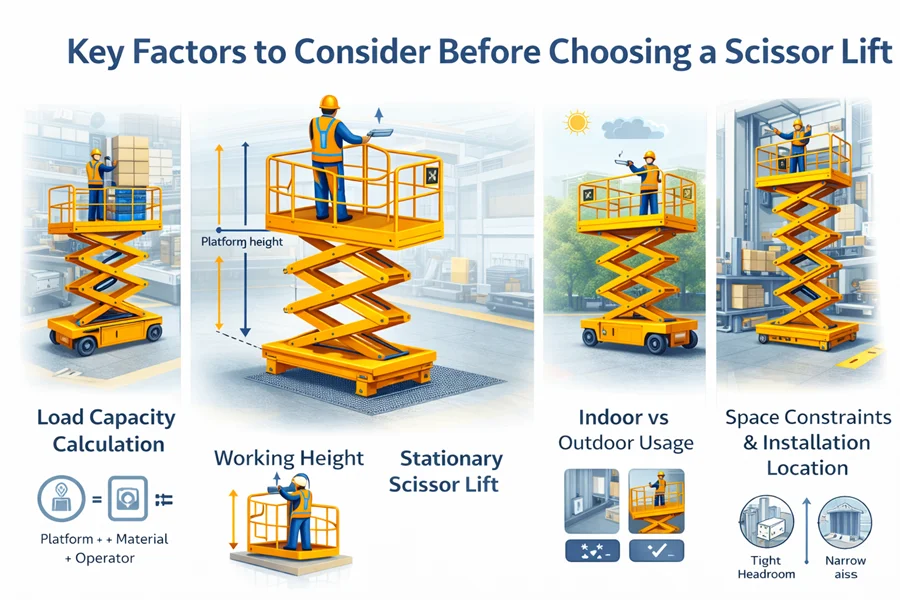
Load Capacity Calculation
Load capacity must include:
- Platform weight
- Maximum material load
- Operator weight
- Tools and accessories
Underestimating load capacity is a common mistake that compromises safety and equipment life. Always consider peak load conditions rather than average loads.
Working Height vs Platform Height
- Platform height is the height the platform reaches
- Working height includes the reach of the operator
Understanding this difference ensures the scissor lift can safely meet access requirements without overstretching its limits.
Indoor vs Outdoor Usage
- Indoor applications prioritise smooth operation, compact design, and clean performance
- Outdoor or semi-outdoor applications require rugged construction and stability
Environmental conditions significantly affect scissor lift selection.
Frequency of Operation
- Occasional use → lighter-duty configurations may suffice
- Continuous or multi-shift use → industrial-grade scissor lifts are essential
Duty cycle directly impacts structural design and component selection.
Floor Conditions and Movement Requirements
Floor strength, levelness, and surface condition influence:
- Lift stability
- Mobility safety
- Load distribution
Mobile scissor lifts, in particular, require careful assessment of floor conditions.
Space Constraints and Installation Location
Limited headroom, narrow aisles, or fixed work zones may require:
- Compact designs
- Customized platform dimensions
- Stationary installations
Ignoring spatial constraints often leads to operational compromises later.
Scissor Lift Safety Features That Should Never Be Ignored
Safety is a critical factor in all industrial lifting operations.
Essential scissor lift safety features include:
- Guardrails to prevent falls
- Emergency stop controls
- Overload protection systems
- Platform stability mechanisms
In Indian factories and warehouses, where workforce density is high, these features are vital for reducing accident risk and ensuring compliance with safety practices.
Stationary vs Mobile Scissor Lift – Which Is Right for Your Facility?
| Parameter | Stationary Scissor Lift | Mobile Scissor Lift |
|---|---|---|
| Movement | Fixed location | Movable within facility |
| Stability | Higher | Depends on floor conditions |
| Ideal Use | Repetitive tasks | Flexible maintenance |
| Space Requirement | Defined area | Requires movement clearance |
| Safety Control | Easier to manage | Requires additional precautions |
The right choice depends on whether consistency or flexibility is the primary requirement.
Common Mistakes Industries Make While Selecting Scissor Lifts
Industries often face issues due to:
- Underestimating load requirements
- Ignoring safety compliance
- Selecting equipment based on cost instead of application
- Using general-purpose lifts for heavy-duty industrial tasks
Avoiding these mistakes improves safety, efficiency, and long-term performance.
When Do You Need a Customized Scissor Lift Solution?
Customization becomes necessary when:
- Platform dimensions are non-standard
- Loads are uneven or unusually heavy
- Integration with conveyors or workstations is required
- Operations run continuously under high stress
Customized scissor lifts are engineered around the application, ensuring better alignment with actual operational needs.
Benefits of Choosing a Manufacturer-Engineered Scissor Lift
Manufacturer-engineered scissor lifts focus on:
- Structural integrity
- Accurate load calculations
- Compliance with industrial safety norms
- Long service life under demanding conditions
Working with an experienced scissor lift manufacturer in India ensures the equipment is designed for real industrial environments rather than generic use cases.
Conclusion
Choosing the right scissor lift for industrial applications is a technical and safety-critical decision. By evaluating load capacity, usage conditions, safety requirements, and operational constraints, industries can select scissor lifts that improve productivity without compromising safety.
A safety-first, application-driven approach ensures that the scissor lift becomes a reliable asset rather than a recurring operational challenge. Informed selection today leads to smoother operations, safer workplaces, and sustainable performance in the long term.