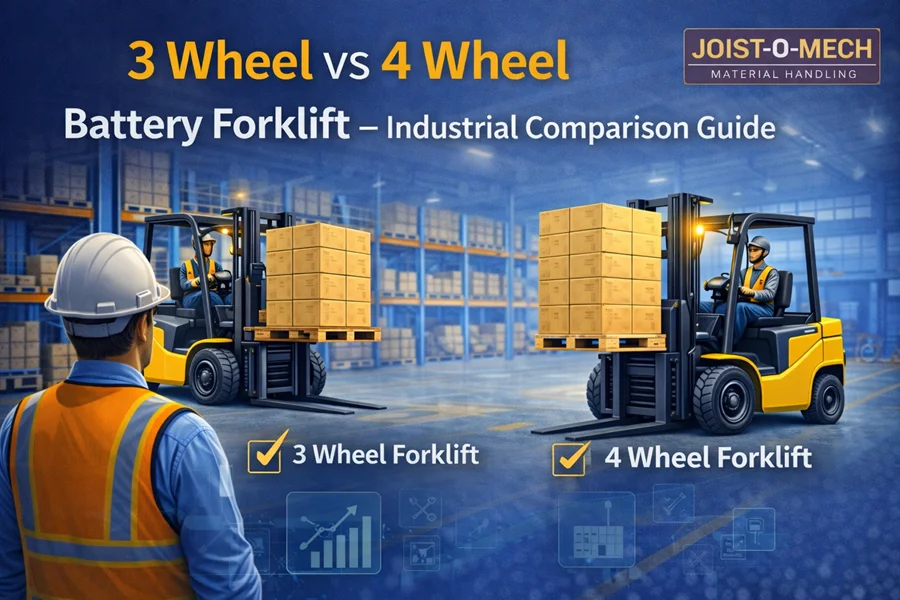
Selecting the right industrial battery forklift is not simply a matter of capacity. In Indian factories and warehouses, forklift choice directly affects aisle efficiency, rack utilization, operator safety, and long-term operating stability. Among the most common evaluation questions procurement and operations teams face is:
3 wheel vs 4 wheel battery forklift – which configuration is better for industrial use?
The answer depends on layout constraints, load profile, duty cycle, and safety expectations. A forklift that performs well in a narrow warehouse may not be suitable for heavy engineering operations. Conversely, a highly stable configuration may sacrifice maneuverability in compact storage environments.
This guide provides a detailed battery forklift comparison from an engineering and operational perspective, helping plant heads and warehouse managers make technically sound decisions.
Understanding Battery Forklifts in Industrial Applications
Battery-powered forklifts, often referred to as electric forklifts, are widely used in indoor industrial operations due to controlled emissions, lower noise levels, and smooth torque delivery. Unlike internal combustion models, battery forklifts rely on electric motors for traction and hydraulic systems for lifting.
Why Battery Forklifts Are Preferred Indoors
In Indian warehouse and factory environments, battery forklifts are preferred because they:
- Operate without exhaust emissions
- Provide consistent torque at low speeds
- Reduce noise in enclosed areas
- Require less engine-related maintenance
Role in Industrial Operations
Battery forklifts are commonly deployed in:
- High-density warehouses
- Manufacturing plants with internal material movement
- Logistics hubs with indoor loading docks
- Assembly and packaging units
However, choosing between a 3 wheel forklift and a 4 wheel forklift requires deeper evaluation of design characteristics.
What Is a 3 Wheel Battery Forklift?
A 3 wheel battery forklift is designed with two front load-bearing wheels and a single rear wheel responsible for steering. This configuration allows the rear wheel to pivot sharply, giving the vehicle a tighter turning radius.
Design Overview
- Single rear steer wheel
- Compact chassis
- Counterbalance structure at rear
Rear-Wheel Steering Mechanism
The single rear wheel enables nearly zero-radius turning capability. This design significantly enhances maneuverability in confined areas.
Key Engineering Characteristics
- Smaller footprint
- Reduced turning radius
- Suitable for narrow aisle movement
- Moderate load capacity
Typical Industrial Applications
3 wheel forklifts are commonly used in:
- Narrow aisle warehouses
- Compact storage facilities
- Light to medium load applications
- Indoor distribution centers
What Is a 4 Wheel Battery Forklift?
A 4 wheel forklift features two front load wheels and two rear wheels, providing a wider base and enhanced stability.
Design Overview
- Four-point contact with floor
- Wider chassis
- Higher structural rigidity
Four-Point Stability
The four-wheel configuration increases lateral stability, especially during turning and elevated load handling.
Key Engineering Characteristics
- Greater load stability
- Higher load capacity range
- Better performance on uneven surfaces
Typical Industrial Applications
4 wheel battery forklifts are widely used in:
- Heavy manufacturing plants
- Warehouses handling heavier pallets
- Engineering units with high stacking requirements
- Mixed indoor-outdoor environments
3 Wheel vs 4 Wheel Battery Forklift – Detailed Comparison
| Parameter | 3 Wheel Battery Forklift | 4 Wheel Battery Forklift |
|---|---|---|
| Turning Radius | Very tight | Moderate |
| Maneuverability | Excellent in narrow aisles | Good but requires more space |
| Stability | Moderate lateral stability | Higher lateral stability |
| Load Capacity | Light to medium loads | Medium to heavy loads |
| Floor Adaptability | Best on smooth indoor floors | Better on uneven or mixed floors |
| Operator Comfort | Compact cabin | Larger cabin, better stability |
| Suitable Aisle Width | Narrow aisles | Wider aisles |
| Typical Application | High-density storage | Heavy industrial material handling |
This comparison highlights that the difference between 3 wheel and 4 wheel forklift configurations is primarily about maneuverability versus stability.
Forklift Stability and Load Handling Differences
Stability Triangle Concept
Forklift stability depends on a triangle formed between:
- Two front wheels
- Rear axle pivot point
In a 3 wheel forklift, the rear pivot point is centralized, enhancing maneuverability but slightly reducing lateral stability.
In a 4 wheel forklift, the wider rear base improves lateral balance.
Impact of Wheel Configuration
- 3 wheel: Better turning, less lateral support
- 4 wheel: Improved stability during cornering and high lift
Load Center Considerations
Load center distance directly affects effective load capacity. Both configurations must be evaluated using load charts to avoid tipping risk.
In Indian warehouse conditions, uneven loading or improper pallet placement increases risk if stability margins are narrow.
Which Forklift Is Better for Narrow Aisle Warehouses?
In high-density storage environments:
- Aisle width often ranges between 2.5 to 3.2 meters
- Rack configuration limits turning clearance
A 3 wheel forklift is generally more suitable for narrow aisles due to:
- Reduced turning radius
- Ability to pivot in tight corners
- Space optimization advantages
However, maneuverability must be balanced against load weight and lift height.
Which Forklift Is Better for Heavy Industrial Loads?
In heavy-duty industrial applications:
- Load weights may exceed standard pallet ranges
- Lift heights may be significant
- Floor strength may vary
A 4 wheel forklift typically provides:
- Higher load stability
- Better lateral balance
- Improved safety margins
For high-duty-cycle operations, the structural support of four wheels reduces long-term stress.
Safety Considerations When Choosing Between 3 and 4 Wheel Forklifts
Safety implications must guide forklift selection.
Stability Under Turning
3 wheel forklifts are agile but require disciplined operation at higher lift heights.
Load Height Risks
As load height increases, center of gravity shifts. Four-wheel designs provide greater tolerance.
Visibility Differences
Operator cabin design and mast structure influence visibility. Larger 4 wheel units may offer improved forward stability but require more space awareness.
Operator Training Implications
Different steering behavior requires specific operator training to maintain compliance and reduce incident risk.
Common Mistakes While Selecting Battery Forklifts
Industries often make selection errors due to:
- Choosing based solely on compact size
- Ignoring load center calculations
- Not measuring aisle width accurately
- Underestimating duty cycle
- Selecting non-industrial configurations
These mistakes lead to reduced efficiency and potential safety risks.
When Do You Need a Customized Forklift Configuration?
Customization becomes necessary when:
- Pallet sizes are non-standard
- Specialized attachments are required
- Warehouses use high rack systems
- Multi-shift operations demand reinforced components
Customized engineering ensures the forklift matches actual operational conditions.
Why Manufacturer-Engineered Battery Forklifts Matter
Manufacturer-engineered forklifts prioritize:
- Accurate engineering calculations
- Structural durability under rated loads
- Stability validation
- Compliance alignment
- Long-term lifecycle reliability
Engineering integrity ensures predictable performance under real industrial workloads.
Conclusion
The choice between a 3 wheel vs 4 wheel battery forklift depends on operational priorities:
- Choose 3 wheel for maneuverability and narrow aisle optimization
- Choose 4 wheel for stability, heavier loads, and higher lift applications
There is no universally superior configuration—only the configuration best aligned with application requirements. Careful technical evaluation, load analysis, and layout assessment ensure that forklift selection enhances productivity while maintaining safety compliance.
An application-driven approach will always outperform assumption-based procurement.